
Every year, lakhs of students sit for the JEE with one dream in mind: a seat at an IIT. A small number of them go on to build companies that change how people eat, shop, pay, search and work.
A graphic shared by Investup Media recently listed 10 successful founders who studied at IIT, and it has been doing the rounds online. Business Connect reviewed public reports, company announcements and filings available as of October 31, 2026, and found that the list has changed a lot since most people last looked at it. Some founders have stepped back from the top job, some have raised fresh capital, and one has been handed a national task by the government.
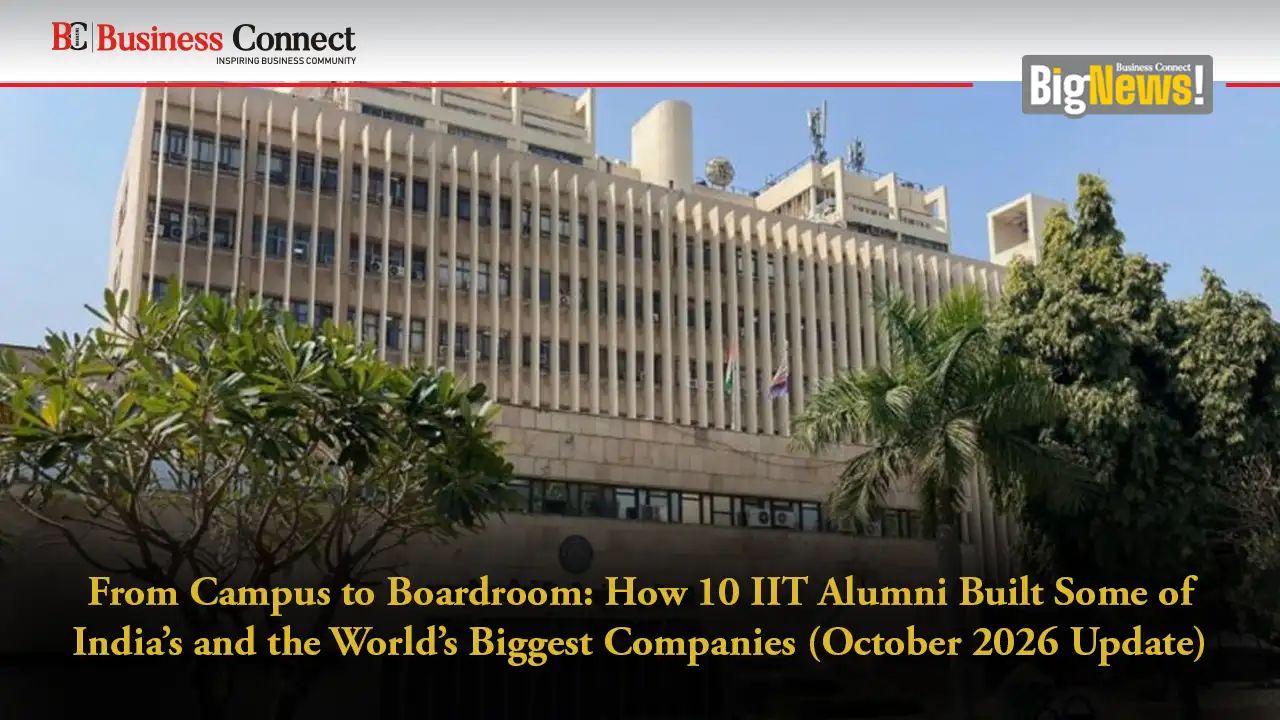
From Campus to Boardroom: How 10 IIT Alumni Built Some of India’s and the World’s Biggest Companies (October 2026 Update)
Here’s where each of these IIT alumni founders stands today.
The List at a Glance
| # | Founder | IIT | Known for |
|---|---|---|---|
| 1 | Deepinder Goyal | IIT Delhi | Zomato / Eternal |
| 2 | Bhavish Aggarwal | IIT Bombay | Ola, Ola Electric, Krutrim |
| 3 | Jay Chaudhry | IIT BHU | Zscaler |
| 4 | Sridhar Vembu | IIT Madras | Zoho |
| 5 | Aravind Srinivas | IIT Madras | Perplexity |
| 6 | Ritesh Arora | IIT Bombay | BrowserStack |
| 7 | Nakul Aggarwal | IIT Bombay | BrowserStack |
| 8 | Sachin Bansal | IIT Delhi | Flipkart, Navi |
| 9 | Rohit Bansal | IIT Delhi | Snapdeal, Titan Capital |
| 10 | Nandan Nilekani | IIT Bombay | Infosys, Aadhaar |
1. Deepinder Goyal (IIT Delhi): From Canteen Menu to a Public Company
Goyal graduated from IIT Delhi in 2005 with an integrated M.Tech in Mathematics and Computing. He and fellow IIT Delhi alumnus Pankaj Chaddah began by scanning canteen menus at their workplace and putting them online. That side project became Zomato, and later Eternal.
The big change this year: Goyal stepped down as Eternal Group CEO effective February 1, 2026, and Blinkit’s Albinder Singh Dhindsa took over, while Goyal stayed on the board as Vice Chairman. He is now working on a new brain-tech start-up called Temple. His letter to shareholders explained that some of his ideas didn’t fit the risk profile of a listed company.
2. Bhavish Aggarwal (IIT Bombay): Building Ola, EVs and AI
Aggarwal built Ola into India’s best-known ride-hailing brand, then moved to electric two-wheelers with Ola Electric and AI with Krutrim. Krutrim became India’s first AI unicorn in January 2024 at a $1 billion valuation.
October 2026 has been busy for him. He pledged a 4.32% stake in Ola Electric to fund his participation in the company’s proposed rights issue of up to ₹1,000 crore. The company had earlier raised ₹780 crore through a qualified institutional placement in June. Investors are watching closely, since the structure links his listed company with his privately held Krutrim group.
3. Jay Chaudhry (IIT BHU): The Cybersecurity Billionaire
Chaudhry earned an electronics engineering degree at IIT BHU before moving to the United States. He built several security companies before Zscaler, which listed on Nasdaq on March 16, 2018. One report puts its fiscal 2026 revenue at about $3.35 billion, up from roughly $2.67 billion the year before.
His net worth estimates vary widely depending on the source and the day’s Zscaler share price, so treat any single figure with caution. What’s clear is that he remains one of the most successful Indian-origin founders in the US.
4. Sridhar Vembu (IIT Madras): The Bootstrapped Software Giant
Vembu built Zoho without outside venture funding. In February 2026, Zoho marked 30 years with more than one million paying customers and over 150 million users worldwide.
He stepped down as CEO in January 2025 to become Chief Scientist, with co-founder Shailesh Kumar Davey taking over as group CEO. Vembu now focuses on research and his rural development mission, which remains central to how Zoho is run.
5. Aravind Srinivas (IIT Madras): India’s Face in the AI Race
Srinivas completed his B.Tech and M.Tech in electrical engineering at IIT Madras before moving to the US for a PhD. He co-founded Perplexity in 2022, and it has grown fast. Reports say it is in talks to raise a new round at a $30 billion valuation, and Srinivas has said it plans to go public in 2028. The $30 billion round has not been confirmed. Reported revenue figures also differ between sources, so look for the company’s own disclosures. Forbes puts his net worth at $2.1 billion.
6 and 7. Ritesh Arora and Nakul Aggarwal (IIT Bombay): The BrowserStack Duo
The graphic lists these two separately, but they built one company together. Both graduated from IIT Bombay in 2006 and founded BrowserStack in 2011. The software testing platform grew mostly on its own money. It became a unicorn after a $200 million round that valued it at $4 billion.
Their 2026 so far:
- BrowserStack announced a $125 million buyback for employees and investors, and expects revenue to cross $300 million by the end of calendar 2026.
- In 2025, they committed ₹100 crore to IIT Bombay to rebuild Hostel 6, where both lived as students, and modernise other hostels.
A common mix-up: this Ritesh Arora is not Ritesh Agarwal, the founder of OYO.
8. Sachin Bansal (IIT Delhi): From Flipkart to Navi
After leaving Flipkart, Bansal started Navi in 2018 and put in large sums of his own money. In August 2026, Navi raised $100 million from Prosus, its first outside institutional funding. The deal values Navi at around $1.3 billion. The company says it reached consolidated profitability in Q4 of fiscal 2026. A planned IPO of about ₹3,000 crore is reportedly on the cards after an earlier attempt stalled in 2023. He is Navi’s Executive Chairman.
9. Rohit Bansal (IIT Delhi): Snapdeal’s Co-Founder, Now an Investor
Bansal co-founded Snapdeal with Kunal Bahl, then co-founded the early-stage investment firm Titan Capital. Titan has backed more than 250 companies. Snapdeal’s parent, AceVector, is heading toward the stock market. It filed updated IPO papers targeting ₹300 crore through a fresh issue. Bahl and Bansal together hold 34.63% and won’t sell shares in the offer. Whether and when it lists is still to be seen.
10. Nandan Nilekani (IIT Bombay): Infosys, Aadhaar and Now Exam Reform
Nilekani co-founded Infosys, served as its CEO from 2002 to 2007, and returned in August 2017 as non-executive chairman. He was also the first chairman of UIDAI, which built Aadhaar.
His latest role is a national one. On July 26, 2026, Prime Minister Narendra Modi announced a high-powered task force on examination reforms under Nilekani’s leadership. He continues as Infosys chairman.
What These Stories Tell Us
Many of them stepped back, on purpose. Goyal, Vembu and Sachin Bansal all moved away from the CEO role, in different ways and for different reasons. Letting go of day-to-day control looks like a growth stage, not a retreat.
Not all of them stayed in India. Chaudhry and Srinivas built their companies in the US, though Srinivas and Chaudhry both remain closely tied to India’s startup story.
Capital paths differ. Vembu and the BrowserStack founders stayed largely bootstrapped. Others raised heavily. Both routes produced successful companies.
The AI wave is everywhere. Srinivas runs an AI company, Aggarwal has Krutrim, BrowserStack is building AI testing agents, and Nilekani has been talking about how AI is changing software work.
Giving back is part of the story. From BrowserStack’s ₹100 crore gift to Nilekani’s earlier donation to IIT Bombay, several of these founders support their alma maters.
IIT is a starting point, not a guarantee. Most of these founders failed at something first, changed direction or built slowly. The degree opened doors, but resilience did the rest.
FAQs
Which IIT has produced the most successful founders on this list?
IIT Bombay and IIT Delhi each have four names in the list (Aggarwal, Arora, Aggarwal and Nilekani for Bombay, and Goyal and the two Bansals for Delhi). IIT Madras has two, and IIT BHU has one.
Is Deepinder Goyal still the CEO of Zomato?
No. He stepped down as Eternal Group CEO on February 1, 2026, and is now Vice Chairman.
Who is Zoho’s CEO now?
Shailesh Kumar Davey, since January 2025. Sridhar Vembu is Chief Scientist.
Which of these IIT founders is leading a government task force?
Nandan Nilekani, on examination reforms, announced in July 2026.
Who founded BrowserStack?
Ritesh Arora and Nakul Aggarwal, both from IIT Bombay.
Does an IIT degree guarantee success as a founder?
No. Many IIT graduates never start companies, and many successful founders didn’t go to IIT. This list simply shows how far some IIT alumni have gone.
Add Business Connect magazine to your Google News feed