
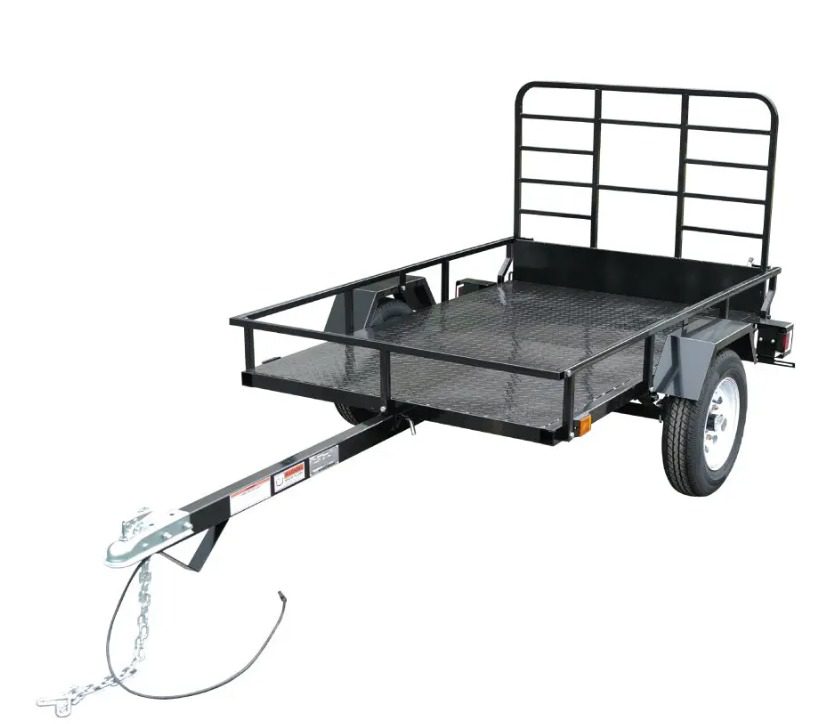
Loading a four foot by six foot single axle utility trailer so the tongue, the axle, and the tow vehicle stay balanced
Summer in Canada fills hardware store parking lots with homeowners hauling mulch, lumber, and lawn tractors, and for many the vehicle that makes it possible is a small trailer behind the family pickup or crossover. The appeal is plain capacity, but the safety lives in how the load is placed.
A single axle utility trailer looks almost too simple to think about, yet the way weight sits on it decides whether it tows straight or fights the driver the whole way home.
One axle means the load has to balance itself
With a single axle carrying the middle of the deck, a utility trailer behaves like a seesaw pivoting on that axle line. Weight set too far back lifts the hitch, and weight crowded too far forward crushes it, so where the heaviest item lands is the first decision.
The suspension under that axle, whether leaf springs or a torsion tube, soaks up road shock and keeps the tire planted. It also sets the ride height, which is why an overloaded deck both bottoms out and bounces the cargo it carries.
- Heavy item first: set it over the axle
- Too far back: hitch lifts and steering lightens
- Too far forward: coupler and tow vehicle sag
Tongue weight is the number that keeps it tracking straight
The download the coupler places on the hitch ball is called tongue weight, and it should sit near a tenth of the total load. Enough of it keeps the trailer following behind the vehicle instead of wandering across the lane.
Too little tongue weight is what starts the dangerous side to side sway that can build until the driver loses the rig. Sliding the load forward a few inches to restore that download is often all the correction a swaying utility trailer needs.
Rails and a tailgate turn a flat deck into a bin
Removable side rails give a utility trailer walls, so loose material like soil or firewood can be piled rather than balanced on an open platform. The rails take the outward push of the load without carrying the deck itself.
A fold down tailgate then doubles as a ramp, letting a mower or wheelbarrow roll up instead of being lifted. Matching the rail height to the cargo is what keeps a light hauler from being asked to carry more than its axle rating allows.
- Side rails: contain loose soil or firewood
- Fold down tailgate: doubles as a loading ramp
- Rail height: match to the cargo carried
Safe towing starts before the wheels ever move
A hitched trailer is only as safe as its connection, so the coupler must seat on the correct ball size and the safety chains cross underneath to cradle the tongue if it ever drops. Crossed chains are a small habit that prevents a runaway.
Checking the tire pressure and the lights before a summer trip rounds out the routine. A utility trailer that leaves the driveway balanced, chained, and lit is one the tow vehicle barely notices behind it.
Seen as a system, the axle, the tongue weight, the rails, and the hitch connection all answer the same question of where the weight goes and how it stays there. Load with the axle in mind and the trailer follows obediently; ignore it and physics takes the wheel.
For the Canadian homeowner hauling through a busy summer, a well balanced utility trailer is the difference between a chore that tows itself and a load that fights back the whole way.