
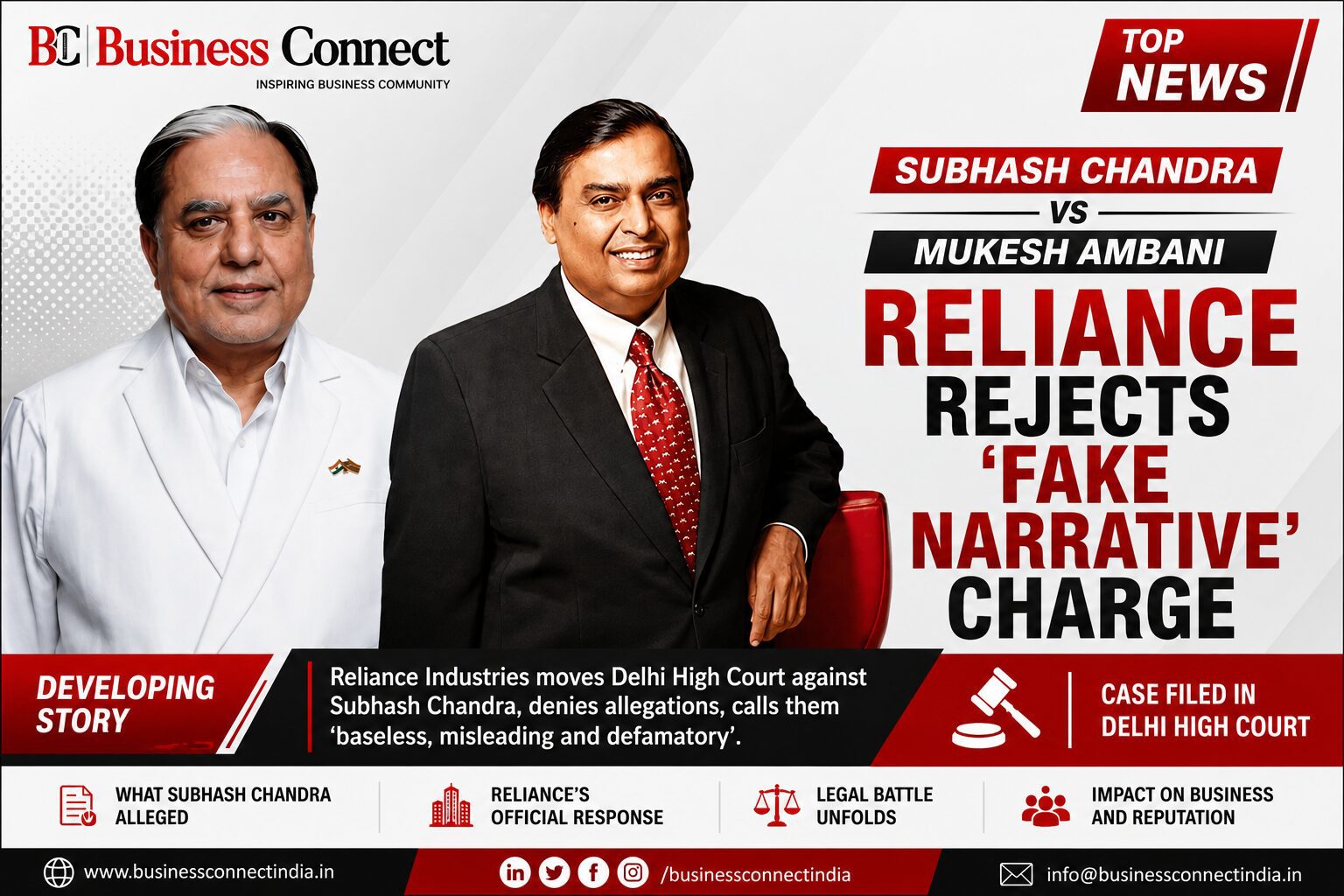
Essel Group chairman Subhash Chandra has publicly named Mukesh Ambani and his media networks — TV18, CNBC, and News18 — accusing them of deliberately spreading a “fake narrative” about his personal insolvency case. Reliance has issued a point-by-point rebuttal, calling the allegations baseless and saying it holds Chandra in high regard. The backdrop is an NCLT order allowing Chandra to settle ₹22,006 crore in admitted creditor claims by paying just ₹6.25–6.5 crore.
Quick Answer — What’s Actually Happening
What Chandra said: For the first time, Essel Group’s Subhash Chandra directly named Mukesh Ambani and his media networks (Network18/TV18/CNBC/News18), accusing them of deliberately spreading a “fake narrative” by circulating the figure of ₹22,000 crore as his personal debt.
What Reliance said: “We have noted with dismay the baseless remarks by Essel Group chairman Subhash Chandra. We strongly deny the allegations and insinuations against the media entities that are a part of the Reliance Group.” The company added its media brands “have never been used to attack anyone, nor will they ever be.”
The legal backdrop: The NCLT approved a personal insolvency settlement under which Chandra pays just ₹6.25–6.5 crore against ₹22,006 crore in admitted claims — a 99.97% haircut for lenders. This triggered the reports Chandra is calling a “fake narrative.”
| Key Point | Details |
|---|---|
| ₹22,006 Cr | Admitted claims against Chandra |
| ₹6.5 Cr | Personal guarantor claims Chandra pays under NCLT order |
| 99.97% Haircut | Haircut for lenders |
| Named | Mukesh Ambani — directly named |
| First Time | Chandra named Mukesh Ambani |
| Rejected | Reliance’s official response |
| Response | “Baseless” — filed with BSE/NSE |
India’s two most powerful media families are now in direct public confrontation — a development that carries significance beyond one corporate dispute and touches on questions about the independence of India’s media landscape, the limits of personal insolvency law, and the use of reputational pressure during legal proceedings. On Thursday, Essel Group chairman Subhash Chandra — the man who built Zee Entertainment into India’s largest television network — named Mukesh Ambani by name for the first time, directly accusing him and the media networks owned by Reliance Industries (TV18, CNBC-TV18, and News18) of deliberately spreading a “fake narrative” designed to tarnish his image during his ongoing personal insolvency proceedings before the National Company Law Tribunal.
Reliance Industries responded the same day. Mukesh Ambani-led Reliance Group refuted the allegations, terming them “baseless” in a statement filed with the BSE and NSE, saying it has noted with dismay the baseless remarks by Essel Group chairman Subhash Chandra and strongly denied the allegations and insinuations against the media entities that are a part of the Reliance Group.
“We strongly deny the allegations and insinuations against the media entities that are a part of the Reliance Group. Our media brands have never been used to attack anyone, nor will they ever be.”
Subhash Chandra’s Allegations
Reliance’s Official Rebuttal
The NCLT Settlement — What the ₹22,006 Crore Figure Actually Means
To understand why this dispute has erupted, it is essential to understand the specific legal proceeding that triggered it. Subhash Chandra is facing personal insolvency proceedings before the NCLT, and last Tuesday, NCLT Member (Judicial) Nilesh Sharma — ruling as a third member of the bench — approved a settlement plan. Under the approved plan, Chandra is required to contribute ₹6.25 crore from his personal assets against admitted claims of ₹22,006 crore.
When reports described this as a 99.97% haircut for lenders, Chandra’s core objection became clear: the ₹22,006 crore figure does not represent money he personally borrowed. Government sources said such an interpretation is misleading because the ₹22,006 crore figure represents claims against Chandra in his capacity as a personal guarantor, rather than money he personally borrowed.
The Personal Guarantor Distinction — Why It Matters
When a company borrows money, banks often require the promoter to personally guarantee the loan — meaning the promoter is personally liable if the company defaults. This is called a “personal guaranty.”
Subhash Chandra’s ₹22,006 crore figure represents what banks claimed against him as a personal guarantor for Essel Group’s corporate debts — not money he personally took from banks for his own use. The distinction matters enormously for public perception: “a man who owes ₹22,000 crore” is a very different claim from “a man who personally guaranteed ₹22,000 crore of corporate borrowings.”
Chandra argues the media — specifically Reliance’s TV18/News18 — deliberately reported the higher figure without this context to damage his reputation during active legal proceedings.
What Chandra Said — The Full Allegations
Chandra, for the first time, directly named Mukesh Ambani, the head of the country’s largest corporate house, and his media networks (TV18/CNBC/News18), accusing them of deliberately spreading a “fake narrative” and “witch-hunting.”
Chandra revealed that after the wrong figure of ₹22,000 crore was circulated in the media, he himself tried to talk to Mukesh Ambani over the phone in this regard and also wrote a letter to him. He said that when a mutual friend called the Network18 editor-in-chief and complained about the loss of credibility, the editor replied, “He has instructions from above and is compelled to do so.”
Chandra also made a pointed personal remark about the Ambani family’s own approach to debt repayment: When Chandra approached Mukesh Ambani with an offer to sell Zee to pay off his debts, Ambani, like a well-wisher, advised him, “Subhash ji, why are you paying back the banks’ money, including interest? No one does.”
“I learnt from Dhirubhai, you didn’t.”
The remark — “I learnt from Dhirubhai, you didn’t” — is a reference to Dhirubhai Ambani, Mukesh Ambani’s father and founder of Reliance, who was widely regarded for his ethical business conduct in his own era. It is one of the sharpest personal barbs Chandra has aimed at the Ambani family.
On his own record, Chandra said: He is a proud corporate citizen of this country who did not run away in times of crisis. The group had a total debt of ₹45,000 crore, of which ₹43,000 crore has been settled by putting his own money back.
What Reliance Said — The Official Response
In a statement issued on August 28, 2026, and filed with the BSE and the NSE of India, Reliance said it was “dismayed” by the insinuations against its media brands. A company spokesperson said Reliance’s media businesses have never been used to attack anyone and would not be used for such purposes in the future. The company also said it continues to hold Chandra in high regard as a businessman and entrepreneur.
The Reliance statement is notable for what it does and does not say. It categorically denies that its media entities were weaponised against Chandra. It professes respect for him. But it does not directly address the specific claims Chandra made — the alleged leaked instruction from “above” to the Network18 editor-in-chief, the alleged Ambani advice about not repaying bank debt, or the alleged Invesco-Zee takeover attempt. The denial is broad; the rebuttals to specific accusations are absent.
Denied: That media brands were used to attack Chandra. That the ₹22,006 crore figure was deliberately circulated as a “fake narrative.”
Did not specifically address: The alleged “instructions from above” comment by the Network18 editor-in-chief. The claimed phone call and letter from Chandra to Ambani. The alleged advice by Ambani to Chandra not to repay bank money. The alleged Invesco-Zee takeover attempt.
The History Behind the Dispute — Chandra, Zee, and Reliance
The NCLT Settlement in Numbers
| Detail / Figure | Fact |
|---|---|
| Admitted claims against Chandra (personal guarantor) | ₹22,006 crore |
| Amount Chandra pays under approved settlement | ₹6.25–6.5 crore |
| Effective haircut for lenders | ~99.97% |
| NCLT member who approved the plan | Judicial Member Nilesh Sharma (third-member ruling) |
| What ₹22,006 crore represents | Claims against Chandra as personal guarantor for Essel Group corporate debt — not money he personally borrowed |
| Lenders’ challenge status | Lenders are challenging the NCLT-approved settlement; proceedings are ongoing |
| Total Essel Group debt settled by Chandra | ₹43,000 crore of ₹45,000 crore total, according to Chandra’s own statement |
Why This Dispute Matters Beyond Two Billionaires
This dispute is not merely a personal quarrel between two of India’s wealthiest men. It raises three questions that matter for India’s media and corporate ecosystem in 2026:
1. Media independence under conglomerate ownership: Reliance now owns Network18 — one of India’s largest media empires, spanning News18 India, CNN-News18, CNBC-TV18, and multiple regional channels. Chandra’s allegation — that editorial decisions at Network18 are made under instruction from corporate leadership — is the most specific public accusation ever made about how Reliance manages its editorial relationships. Reliance’s denial is categorical, but the allegation now exists in the public record.
2. The personal guarantor precedent: The NCLT settlement allowing Chandra to pay ₹6.25–6.5 crore against ₹22,006 crore in admitted claims is significant for Indian banking and insolvency law. If personal guarantor claims of this magnitude can be settled for a fraction of a percent, it raises serious questions about the deterrent value of personal guarantees — and about whether lenders, mainly banks and mutual funds, are being adequately protected.
3. The Zee-Sony-Reliance power dynamics: With the Zee-Sony merger collapsed, Zee Entertainment’s future is uncertain, and Chandra’s personal insolvency proceedings reduce his direct leverage over what remains. The Invesco episode Chandra referenced, combined with his direct accusation of Ambani coordination in an attempted Zee acquisition, suggests the battle for control of India’s largest entertainment brand is far from over.
Important Caveats
All allegations by Subhash Chandra against Mukesh Ambani and Reliance’s media entities are his own statements and have been flatly denied by Reliance in an official stock exchange filing. Chandra’s claims about a Network18 editor-in-chief receiving “instructions from above” and about an alleged Ambani quote advising against repaying bank debt are currently unverified by any independent source. Reliance has not filed any legal action against Chandra’s statements as of the time of publication.
The lenders challenging the NCLT settlement are doing so through legal channels — their legal arguments are separate from and unrelated to the Chandra-Reliance media dispute.
Frequently Asked Questions
What exactly did Subhash Chandra accuse Mukesh Ambani and Reliance of?
Subhash Chandra alleged that Reliance’s media networks, including TV18, CNBC-TV18 and News18, circulated what he described as a “fake narrative” by presenting the ₹22,000-crore figure as his personal debt without providing the full context. He alleged that this was intended to damage his reputation while his NCLT proceedings were ongoing. Chandra also claimed that a Network18 editor-in-chief had indicated that there were instructions “from above” regarding the coverage. In his allegations, Chandra directly named Mukesh Ambani.
What was Reliance’s official response?
Reliance issued a statement filed with the BSE and NSE, describing Chandra’s allegations as “baseless.” The company said its media brands have never been used to attack anyone and would never be used for such a purpose. Reliance also said it holds Chandra in high regard and wishes him well. The response did not specifically address several of the individual allegations made by Chandra, including the alleged editorial instructions, the alleged Ambani remark about debt repayment, or the alleged Invesco-Zee takeover attempt.
Is Subhash Chandra really paying just ₹6.5 crore against ₹22,006 crore in claims?
Under the NCLT-approved settlement, Chandra is required to pay approximately ₹6.25–6.5 crore from his personal assets against admitted claims of ₹22,006 crore. This works out to roughly 0.03% of the admitted claims, implying an effective haircut of around 99.97% for lenders. However, the ₹22,006-crore figure relates to claims against Chandra in his capacity as a personal guarantor for Essel Group’s corporate borrowings, rather than money he personally borrowed. Lenders have challenged the NCLT-approved settlement, and the legal proceedings remain ongoing.
What is the “I learnt from Dhirubhai, you didn’t” remark about?
The remark refers to Dhirubhai Ambani, Mukesh Ambani’s father and the founder of Reliance. Chandra used the statement as a pointed criticism of Mukesh Ambani, suggesting that the business values and principles he says he learned from Dhirubhai have not been followed by Mukesh Ambani. The comment was made in the context of Chandra’s broader allegations concerning Ambani and the repayment of bank debt. These statements represent Chandra’s allegations and interpretation, not an established finding of fact.