
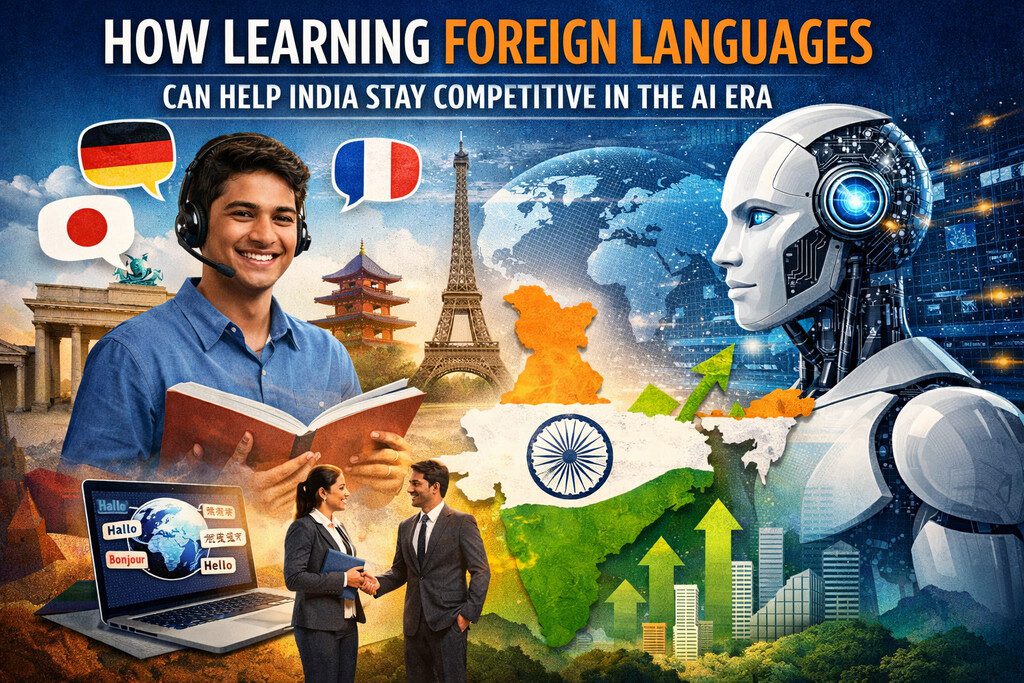
Artificial Intelligence is transforming industries across the globe. From automated customer service to AI-powered data analysis and translation tools, technology is rapidly reshaping the nature of work. While these advancements offer efficiency and productivity, they also raise an important question: how can professionals remain competitive in an AI-driven world?
For India, one powerful answer lies in foreign language education. As automation replaces routine tasks and global collaboration becomes more important, language skills can give Indian professionals a unique advantage in the global economy.
The Changing Nature of Work in the Age of AI
Artificial intelligence is increasingly capable of performing repetitive and data-driven tasks. Industries such as customer service, content generation, translation, and even coding are experiencing significant automation. As a result, professionals need to develop skills that complement AI rather than compete with it.
Human abilities such as cultural understanding, communication, creativity, and relationship-building are difficult for machines to replicate. Language learning strengthens exactly these kinds of skills. When individuals learn a new language, they also develop deeper cultural awareness and the ability to communicate effectively across borders.
These qualities are becoming extremely valuable as companies expand their international operations and require professionals who can collaborate with global teams.
Globalization Is Expanding Opportunities
India’s economy is increasingly connected to global markets. Indian professionals work with international clients, multinational corporations, and global supply chains. In this environment, communication skills across languages are becoming essential.
Countries such as Germany, France, Japan, and Spain maintain strong economic ties with India. Many of these countries offer opportunities in engineering, healthcare, manufacturing, research, and technology. However, professionals who can communicate in the local language often have a clear advantage.
Learning a foreign language helps individuals understand cultural differences, improve professional communication, and build stronger international relationships. It also enables professionals to access career opportunities that might otherwise remain out of reach.
Institutions such as the Indian Institute of Foreign Languages help students and professionals develop these skills so they can confidently engage in international careers.
Language Skills and International Careers
Many Indian students today aspire to study or work abroad, particularly in countries known for strong economies and advanced industries. Germany, for example, has become a popular destination for students and professionals because of its engineering excellence, research opportunities, and strong job market.
However, language remains one of the most important factors for success in these environments. Even when English is used in professional settings, knowledge of the local language significantly improves career prospects and everyday life.
For instance, professionals who complete German online language courses can increase their chances of working with German companies, pursuing higher education in Germany, or collaborating with European organizations.
Why AI Cannot Replace Human Communication
Although AI-powered translation tools have improved dramatically, they still cannot fully replicate human communication. Language is not just about words and grammar—it includes cultural context, tone, emotion, and social understanding.
In international business, these elements play a critical role. Negotiations, partnerships, and teamwork often depend on subtle cultural signals that machines cannot easily interpret.
Professionals who understand both language and culture are better equipped to build trust, avoid misunderstandings, and create long-term relationships. This human dimension of communication ensures that language skills remain valuable even as AI technology continues to evolve.
Cognitive and Professional Benefits
Learning a foreign language also strengthens several cognitive abilities that are useful in modern workplaces. Research suggests that multilingual individuals often demonstrate stronger memory, better problem-solving skills, and improved adaptability.
These cognitive benefits make language learners more flexible and innovative—qualities that are particularly valuable in a rapidly changing technological landscape.
Furthermore, language learning encourages curiosity and global awareness. Professionals who understand different cultures and perspectives are often more effective when working in diverse teams or managing international projects.
India’s Opportunity in the Global Economy
India has one of the largest youth populations in the world. As millions of young professionals enter the workforce each year, the country has a unique opportunity to build a globally competitive talent pool.
If Indian professionals combine technical expertise with multilingual communication skills, they can significantly expand their presence in international industries. Engineers, healthcare workers, entrepreneurs, and researchers who speak multiple languages will find it easier to collaborate with global partners and access new markets.
In this way, language education can become a strategic advantage for India in the age of artificial intelligence.
Preparing for the Future
The rise of AI does not mean the disappearance of human skills. Instead, it highlights the importance of abilities that machines cannot easily replicate. Communication, cultural understanding, and relationship-building will continue to shape global business and international cooperation.
Foreign language learning equips individuals with these essential capabilities. It enables professionals to connect with people across cultures, navigate international environments, and build careers that extend beyond national borders.
As India continues to grow as a global economic power, developing multilingual talent will play an important role in ensuring that the country remains competitive in the AI era.