
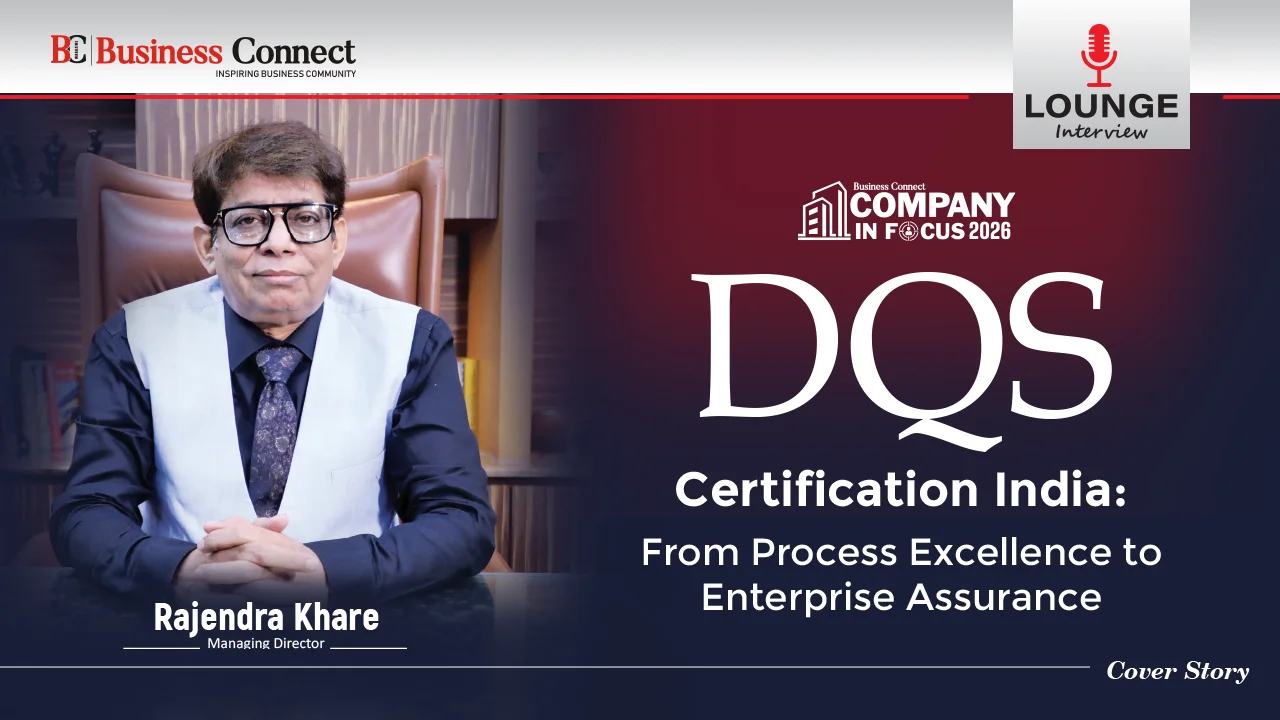
Built upon Rajendra Khare’s vision of organizational excellence, DQS Certification India, operating as AFNOR India, brings together Indian professional expertise, international standards leadership and an expanding portfolio of enterprise assurance services.
The evolution of DQS Certification India reflects a larger transformation in Indian industry: from the early adoption of international quality standards to the growing recognition that organizational excellence demands coordinated management of processes, technology, governance and risk. At its foundation lies a conviction that certification must represent genuine capability rather than become an exercise in acquiring credentials.
Today, operating as AFNOR India, the company combines its established Indian professional legacy with the international resources of AFNOR Group. Its progression from conventional management-system services towards wider enterprise assurance reflects both the changing requirements of Indian businesses and the intellectual philosophy of its founder, Rajendra Khare.
A Legacy Rooted in India’s Quality Transformation
DQS Certification India emerged when ISO 9001:1987 and its 1994 revision were introducing Indian enterprises to structured quality management. International competition increasingly demanded reliable processes, managerial accountability and consistent performance. Standards offered organizations a systematic means of improving operations while demonstrating credibility to customers and international markets.
Originally established as Delhi Quality Services, the company embodied the vibrancy and entrepreneurial ambition of its namesake city. Its founding purpose was to make process improvement and organizational excellence accessible to Indian enterprises. Over the years, DQS Certification India developed activities encompassing management-system certification, assessment, professional training and process improvement, responding to the emergence of environmental, occupational safety, informationsecurity and other management disciplines.
Khare describes the company’s essential character as an “enabling business,” helping organizations develop the process capabilities needed to serve customers better. This philosophy has shaped its development: certification is valuable not merely as external recognition but as an instrument through which enterprises strengthen their own performance.
Rajendra Khare: The Intellectual Foundation of Enterprise Excellence
Behind this institutional journey stands Rajendra Khare, a self-made professional whose ascent from exceptionally humble beginnings reflects perseverance and intellectual accomplishment. His father’s untimely death brought severe financial hardship, compelling him to support his education through private tuition and newspaper distribution.
His determination earned him a National Scholarship, the Chancellor’s Gold Medal at university graduation and subsequent research experience at the National Institute of Immunology. His professional career encompassed senior responsibilities in the Government of India’s Department of Commerce, Indian Railways, Indian Oil Corporation and KPMG, where he served as Associate Director.
His qualifications span Lead Assessor disciplines covering quality, environment, occupational health and safety, automotive quality, information security and IT service management, alongside advanced CMMI appraisal and instructional qualifications. Khare’s influence upon DQS Certification India extends beyond professional credentials. His originality of thought and ability to demystify complicated management concepts have shaped the company’s approach to clients.
Rather than treating standards as abstract technical prescriptions, he examines their underlying logic and translates them into intelligible business practices, making sophisticated organizational disciplines accessible to decision-makers and operating teams alike.
AFNOR: A Century of International Standards Leadership
Founded in France in 1926, AFNOR Group celebrates its centenary in 2026, marking a century of contributions to standardization and organizational development. As a founding member of the International Organization for Standardization, AFNOR possesses institutional knowledge accumulated through successive transformations in industry, technology and international commerce. For DQS Certification India, its longstanding association with AFNOR has broadened the services available to Indian enterprises.
Operating as AFNOR India, the company brings internationally recognized certification, training and technical expertise to customers while drawing upon AFNOR Group’s specialists, methodologies and emerging standards capabilities.
The relationship supports the introduction of newer management disciplines as business requirements evolve. Khare places particular importance on the character of this partnership, observing that AFNOR has “always treated us as an equal partner.” For an Indian enterprise working alongside an international institution, this relationship combines global recognition and professional resources with local market understanding, commercial responsiveness and continuity of purpose.
Describing what AFNOR has meant to the company’s growth, Khare says: “It is very considerate on the needs of the other side plus it is very fair in its dealing. Interestingly with AFNOR, they’ve always treated us as an equal partner and they have given all the rights and fairness that could be held in a partnership, and the testimony to that is our 20 year old relationship with them.” He adds: “The partnership with AFNOR actually gives you the capability to deliver high quality service, in-depth professional competence that they provide, plus a sense of equality and not a sense of working with a dominant partner but with a benevolent partner.”
Beyond Certification: Understanding the Enterprise as an Integrated System
Organizations frequently implement management standards through separate functional arrangements. Quality, environment, occupational safety, information security and business continuity may each have distinct procedures, responsibilities and assessment mechanisms.
Although individually effective, fragmented implementation can obscure the relationships that determine overall organizational performance. Drawing upon experience across multiple management disciplines, DQS Certification India supports organizations through certification, assessment, training and improvement-oriented engagements. AFNOR India’s approach encourages coordinated management practices, common risk-assessment principles and operational procedures that address several requirements without creating unnecessary administrative duplication.
Khare explains the underlying principle succinctly: “These processes do not act in isolation.” He advocates integrated operating procedures through which employees can fulfil several management-system obligations naturally within their daily responsibilities. The objective is not simply to combine documentation, but to make organizational management more coherent and effective.
Elaborating on how this works in practice, he says: “When it comes to being performed at the ground level, at the individual level, he should not feel that he’s implementing the 27001 standard here and the 22301 standard here. He should be having a set of SOPs which kind of cover all of them. So he doesn’t have to look at a separate SOP for cyber security, a separate SOP for business continuity.”
Corporate Governance and the Emerging Architecture of Accountability
Corporate governance increasingly requires demonstrable effectiveness rather than formal compliance alone. Boards must establish reliable oversight, understand material risks and ensure that policies translate into appropriate conduct throughout the enterprise. A single operational failure can damage institutional credibility accumulated over many years. Building upon its management-system assessment experience, AFNOR India identifies governance, enterprise risk management and internal-control assurance as areas for strategic development.
These include evaluating control design and effectiveness, strengthening accountability and applying principles relevant to regulatory compliance and SarbanesOxley-related control disciplines. Khare compares a corporation to an organism whose board functions as the brain while its operational units perform countless individual transactions.
His observation that “at the transaction level you need to have effective controls” captures a central governance requirement: leadership direction must reach everyday operations, while reliable information must flow back to those responsible for oversight.
He explains why this matters: “A small transaction in the market level could even spoil your reputation that has been built over the ages. So that is why the governance has to flow both sides, it has to go from up and it should be coming down. Governance plays a big role because the board level decisions impact the decisions at the ground level and reverse is also true.”
Cybersecurity, Privacy and the Foundations of Digital Trust
Digital transformation has elevated cybersecurity from a specialized technical concern to an enterprise-wide responsibility. Information breaches, operational disruptions and failures of confidentiality can undermine customer confidence and commercial relationships, making effective information-security management indispensable.
AFNOR India addresses these requirements through information-security certification, assessment and training capabilities, drawing upon ISO/IEC 27001 and related management disciplines. Privacy information management under ISO/IEC 27701 and business continuity under ISO 22301 provide complementary approaches to protecting information, sustaining operations and strengthening organizational resilience.
Khare argues that “cyber security is not a technology issue,” emphasizing that technological controls alone cannot establish dependable protection.
Employee awareness, disciplined behaviour, management commitment and appropriate investment must operate together. This philosophy informs the company’s emphasis on organizational controls alongside technical safeguards. In Khare’s words: “Cyber security has many dimensions and the important part is that it has to become a culture of the organization.
Every individual should understand the importance of cyber security, and the only thing is that things go wrong when we consider it’s a technology issue rather than an organization-wide issue.”
CMMC and the Commercial Significance of SupplyChain Cybersecurity
Cybersecurity requirements increasingly influence participation in international supply chains, particularly those connected with sensitive government and defense-related information.
The United States Department of Defense’s Cybersecurity Maturity Model Certification framework links applicable contractual obligations with demonstrable implementation of prescribed security safeguards.
AFNOR India identifies CMMC readiness as an emerging service opportunity for Indian suppliers operating within relevant international contracting arrangements. Its prospective activities include gap assessment, assessment-boundary definition, implementation preparedness and evaluation of supporting evidence, building upon established informationsecurity competencies without implying authorization to conduct official CMMC certification assessments.
The company’s approach recognizes that cybersecurity preparedness must extend beyond documentary compliance. Effective protection requires coordinated responsibility among leadership, technical specialists and operational personnel, reflecting Khare’s broader conviction that organizational security depends upon an informed and disciplined workforce.
Sustainability, Carbon Accountability and the Changing Economics of Trade
Environmental responsibility increasingly influences market access, procurement decisions and investment. Carbon emissions, energy efficiency and supply-chain transparency have become commercially significant considerations, requiring organizations to develop reliable environmental information and integrate sustainability into operational decisions.
AFNOR India draws upon environmental management experience and AFNOR Group’s international resources to address these changing requirements. The company is presenting CBAM-related services to Indian industries, particularly sectors exposed to European carbonborder requirements, while pursuing opportunities in emissions-data preparedness, carbon-accountability support and the development of verification capabilities as the applicable accreditation framework permits.
Khare is clear about the opportunity: “The European FTA is already signed and the European importers would be requiring Indian exporters to have their carbon results being verified and validated, and so CBAM would be something which is very critical in coming 3-4 years. AFNOR has already brought this service to the market.” He is realistic about the pace, adding that “it may take some time to pick up but coming three to five years this is going to become increasingly significant.”
Khare emphasizes that sustainability “has to be implemented in the supply chain also.” His perspective extends environmental accountability beyond the enterprise’s own facilities to procurement choices, supplier practices and product lifecycles. The resulting challenge is both managerial and commercial: organizations must reconcile environmental commitments with cost, competitiveness and long-term resilience.
Management Systems, CMMI and the Institutionalization of Excellence
Management systems provide the structural foundations through which enterprises convert intentions into repeatable practices. ISO 9001 addresses quality, ISO 14001 environmental management, ISO 50001 energy performance and ISO 22301 business continuity. Their common principles include leadership, risk-based thinking, performance evaluation and continual improvement.
DQS Certification India’s professional capabilities encompass management-system certification, assessment, training and process improvement. Its CMMI experience adds a complementary dimension through process capability, organizational maturity and predictable performance in development, services and acquisition environments. Khare’s earlier work in making sophisticated maturity models accessible to smaller enterprises illustrates the company’s emphasis on practical applicability rather than organizational size.
He identifies an often-overlooked benefit of management systems: their capacity to become “a tool of building up a strong positive culture of organizational discipline.” For AFNOR India, the value of certification therefore extends beyond independent recognition to the institutionalization of practices that support dependable performance. He is equally candid about the limits of a certificate: “Having a certificate is risky if you are not really deserving that certification.
There should be a complementarity between deserving the certificate and having the certificate, and both have to stand at the equal platform. Certificate is about compliance whereas the ISO standards really want that you should comply and you should excel.”
Artificial Intelligence and the Transformation of Assurance
Artificial intelligence offers considerable opportunities for innovation and productivity while introducing new challenges involving transparency, reliability, bias, accountability and technological risk. Enterprises adopting AI must establish governance arrangements that keep development, deployment and operational use aligned with responsible management.
AFNOR India’s work in artificial intelligence management includes ISO/IEC 42001 certification engagements involving major Indian corporations, as described by Khare in his recent interview. His experience of assessing AI management arrangements highlights the need for coordination among developers, business users and governance teams, with appropriate attention to regulatory obligations, ethical considerations and validation of AI applications. Khare describes how AFNOR enabled this work: “Lately we have AI arriving in the world and so the standardization community led by ISO developed a standard called ISO 42001, which is an artificial intelligence management system. AFNOR gives us the capability to provide this service and we have provided ISO 42001 certification to many large corporations in India. These are the early days, so there’s a lot of learning in the 42001 certification and we at AFNOR India are enjoying this process.”
Khare insists that “AI governance as well as AI development” must be considered together. His central concern is that innovation without corresponding organizational discipline can expose enterprises to significant risks. The company’s experience in AI management-system assessment consequently provides a practical foundation for its continuing development of technology-related assurance capabilities
AFNOR India’s Strategic Vision: Towards Integrated Enterprise Assurance
The future of enterprise assurance lies increasingly in understanding how different organizational disciplines interact. Businesses require confidence not merely in individual certificates but in the combined effectiveness of their governance arrangements, operating processes, information-security controls, environmental responsibilities and technological safeguards. AFNOR India’s strategic direction brings together five complementary fields: sustainability and carbon accountability; cybersecurity, privacy and CMMC readiness; governance and internal controls; artificial intelligence and digital assurance; and management systems and process maturity.
Established certification, assessment and training activities provide the foundation, while emerging services respond to changing regulatory and commercial expectations. DQS Certification India’s accumulated experience, AFNOR Group’s international knowledge and Rajendra Khare’s intellectual leadership give this direction a coherent institutional basis. The ambition is to help enterprises progress beyond fragmented conformity towards management practices that reinforce one another and deliver measurable organizational value.
Excellence, Assurance and the Enduring Currency of Trust
The journey from Delhi Quality Services to DQS Certification India and its contemporary identity as AFNOR India represents continuity amid transformation. What began with the conviction that disciplined management could elevate Indian enterprises has acquired an international dimension without surrendering its original purpose of making organizational excellence attainable and demonstrable.
There is a deeper symmetry between the institution and its founder. Khare’s ascent from adversity through scholarship, perseverance and self-reliance reflects the philosophy he brought to enterprise development: lasting achievement is built through knowledge, discipline and the courage to question established assumptions. His conviction that organizations must move “from compliance to excellence” captures the principle animating this journey.
As technology advances, regulations multiply and business relationships become increasingly intricate, enterprises will continue seeking something more enduring than compliance: confidence that their systems are sound, their decisions responsible and their commitments dependable. It is in creating that confidence— where knowledge becomes capability, discipline becomes excellence and assurance becomes trust— that the enduring purpose of DQS Certification India finds its fullest expression.
Add Business Connect magazine to your Google News feed