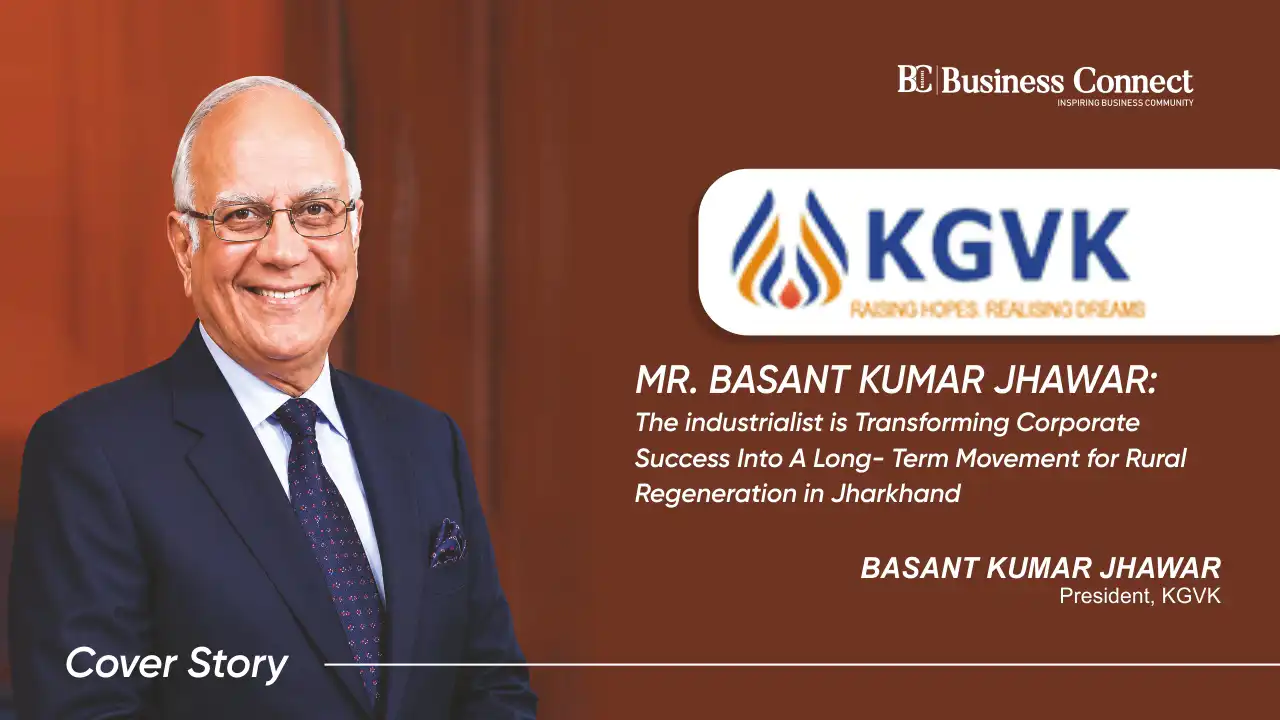
We often read about leaders who build companies but seldom learn about who build ecosystems. Mr. Basant Kumar Jhawar is an incredible industrialist who falls in the second category. Widely recognized as one of the pioneering industrialists behind Usha Martin Limited, Mr. Jhawar helped shape one of India’s most respected enterprises transforming a modest wire rope manufacturing venture into a globally recognized organization with operations spanning multiple continents.
His contribution to India’s industrial growth story remains significant, particularly in the fields of wire ropes and specialty steel manufacturing. But little did people know that behind the boardroom achievements and industrial expansion was a deeply human concern that would eventually define his legacy far beyond business.
As industries grew around Jharkhand, Mr. Jhawar began observing another India existing in parallel: villages struggling with water scarcity, declining agriculture, limited healthcare access, fragile livelihoods, and the steady migration of rural youth in search of survival. The contrast stayed with him. And somewhere between factories and farmlands, a larger vision began to take shape.
That vision eventually took shape as Krishi Gram Vikas Kendra, later renamed KGVK (www.kgvk.org) in 1972—an institution that has redefined the meaning of rural development in Jharkhand for more than five decades.
Building more than an organisation
This institution stands firm on the philosophy rooted in dignity, participation, and sustainability. At a time when rural development was largely treated as charity-driven intervention, KGVK adopted a fundamentally different approach. The organization believed villages should not become dependent on aid but become selfsustained and capable of shaping their own future.
This idea became the foundation of KGVK’s long-term developmental vision that combined community participation, sustainable resource management, local leadership, and institutional collaboration under a single framework. Over time, this evolved into KGVK’s proprietary Total Village Management (TVM) model.
Unlike fragmented development programs that addressed one issue at a time, TVM approached villages as interconnected ecosystems where water, agriculture, forests, livestock, health, education, livelihoods, and governance all influence one another.
At the centre of this model emerged the now widely recognized “5Js” framework:
- Jal (Water)
- Jameen (Land)
- Jangal (Forest)
- Janwar (Livestock)
- Jan (People)
The philosophy was straightforward yet profound which stated that unless all five elements evolve together, rural poverty eventually returns in another form.
This systems-based thinking became one of KGVK’s greatest strengths. Instead of imposing external solutions, the organization worked closely with communities to identify local challenges, understand root causes, and create participatory action plans. Villagers themselves became active contributors in development rather than passive beneficiaries. Over the years, this communityled model has become the identity of KGVK.
Exceptional transformation of KGVK in the five decades
Mr. Jhawar has enormous enthusiasm and generates ideas which are way ahead of his time. His vision for rural development was far ahead of its time, rooted in the belief that true progress begins at the grassroots level. Driven by deep passion and social commitment, he consistently worked towards empowering rural communities through sustainable development, selfreliance, and long-term upliftment initiatives that continue to create meaningful impact even today.
KGVK’s five-decade journey is not just the story of an organization growing over time. In many ways, it also mirrors how the understanding of rural development itself evolved in India.
In its early years during the 1970s and 1980s, KGVK worked closely with rural and tribal communities across Jharkhand at a very grassroots level. These were years of learning as much as intervention.
The organization focused on understanding local realities, listening to communities, and finding ways to combine traditional rural knowledge with practical scientific approaches. The work may have started on a modest scale, but the thinking behind it was already long-term.
As the years progressed, KGVK’s role naturally began to expand. What initially revolved around agriculture and village development slowly grew into a much wider effort that included healthcare, education, livelihoods, women’s participation, and community welfare.
Around this phase, the organization also began moving from purely philanthropic work toward more structured development programmes through collaborations with government bodies, funding institutions, and development agencies. That transition helped bring both scale and continuity to its work.
By the late 1990s and early 2000s, Natural Resource Management had emerged as one of KGVK’s strongest areas of intervention.
Large watershed and land restoration projects were undertaken across regions such as Ranchi, Ramgarh, and Saraikela-Kharsawan under programmes including Integrated Watershed Management Programme (IWMP), Integrated Waterland Development Programme (IWDP), Drought prone Areas Programme (DPAP), and India Canada Environment Facility (ICEF).
These initiatives focused on restoring degraded land, improving irrigation access, conserving water resources, and strengthening the ecological balance in rural areas that had long struggled with resource depletion.
But what made KGVK’s approach different was that the work never stopped at environmental restoration alone. The organization understood very early that rural transformation cannot happen in fragments. Improving land without improving livelihoods, healthcare, education, or local participation would only solve part of the problem.
So, while watersheds were being rebuilt, equal attention was also being given to the people living around them like their incomes, their health, their opportunities, and their ability to sustain change over the long term.
The organization understood that sustainable development must also improve everyday quality of life.
Healthcare programs focused on maternal care, nutrition, sanitation, immunization, adolescent health, and access to safe drinking water. Village Health, Sanitation and Nutrition Committees were strengthened to improve local participation and accountability.
Projects such as solar-based drinking water systems, school sanitation infrastructure, and nutrition interventions significantly improved health indicators in operational areas. Education became another major pillar of intervention.
KGVK’s Total Education model emphasized childfriendly learning, teacher training, learning resource centres, and improving educational quality at the grassroots level. The focus was not merely enrollment, but meaningful learning experiences for children from underserved communities.
Meanwhile, livelihood generation programs introduced modern agricultural practices, crop diversification, livestock management, market linkages, and microenterprise opportunities. Rural women were organized into self-help groups, enabling financial participation and local leadership. Skill development initiatives created pathways for youth employment and entrepreneurship.
By the 2010s, KGVK had emerged as one of the most recognized institutions in holistic rural transformation within Jharkhand.
Its village development model had become increasingly data-driven, participatory, and scalable. Collaborations with organizations such as the Austrian Development Agency, Sir Ratan Tata Trust, HDFC Bank, Axis Bank Foundation, ICICI Bank, National Bank of Agriculture & Rural Development (NABARD), The Energy and Resources Institute (TERI), and several government bodies further strengthened its reach and institutional credibility.
What made these partnerships successful was KGVK’s ability to translate policy into practical grassroots implementation. The organization consistently demonstrated that sustainable rural development is most effective when communities, institutions, corporates, and governance systems work together rather than independently
About The Leadership Mantra
What makes Mr. Basant Kumar Jhawar’s journey particularly compelling to us is that he never saw business and social responsibility as two separate worlds. While building large industrial enterprises and navigating decades of corporate leadership, he also remained deeply conscious of the realities outside boardrooms and factory gates.
He has been very well aware of how institutions are built, how systems function, and what it takes to sustain growth over a long period of time. But somewhere along the way, he also realized that growth means very little if it does not eventually reach people at the grassroots.
That thinking slowly became the foundation of KGVK’s working philosophy. The organization was never designed to function like an outside agency arriving with ready-made solutions. Instead, the focus was always on working alongside communities i.e. to help villages identify their own strengths, encouraging local leadership, and creating systems that people could eventually sustain on their own.
Perhaps that is why KGVK’s work has continued to stay relevant across generations rather than becoming just another development initiative tied to a particular moment in time.
Something is even more striking i.e. how naturally this vision aligns with today’s global conversations around sustainability, climate resilience, community participation, and responsible growth. Long before terms like ESG and sustainable development became part of mainstream corporate language, KGVK had already been practicing many of these ideas on the ground. In many ways, Mr. Jhawar’s vision did not simply age well, but quietly moved ahead of its time.
A legacy that continues to grow
The mission of the institution remains the same, even after five decades. KGVK’s journey, from a humble rural initiative started in 1972 to an esteemed institution in integrated rural development, is a strong testimony to the power of long-term commitment.
The organization’s work can be seen across villages in Jharkhand not only in infrastructure or statistics but in restored confidence, improved livelihoods, empowered women, healthier communities, and villages that increasingly shape their own future. And at the heart of this 5-decade journey is the timeless vision of Mr. Basant Kumar Jhawar.
A vision that proved industry and empathy can coexist. That economic growth and social responsibility can go hand in hand.
And that real leadership is measured not just by the enterprises one builds, but the lives one has transformed during our time in this planet as privileged human being. His passion for uplifting others is immense, and his story of love and service continues even after stepping away from active business roles.”