
In the Preschool education space, there is a quiet shift happening in Indian households today. Parents are no longer only asking whether their child can recite alphabets, count numbers, or finish homework on time. Increasingly, they are asking something else altogether: Is my child happy while learning? Is my child confident? Is school becoming a place of joy or pressure?
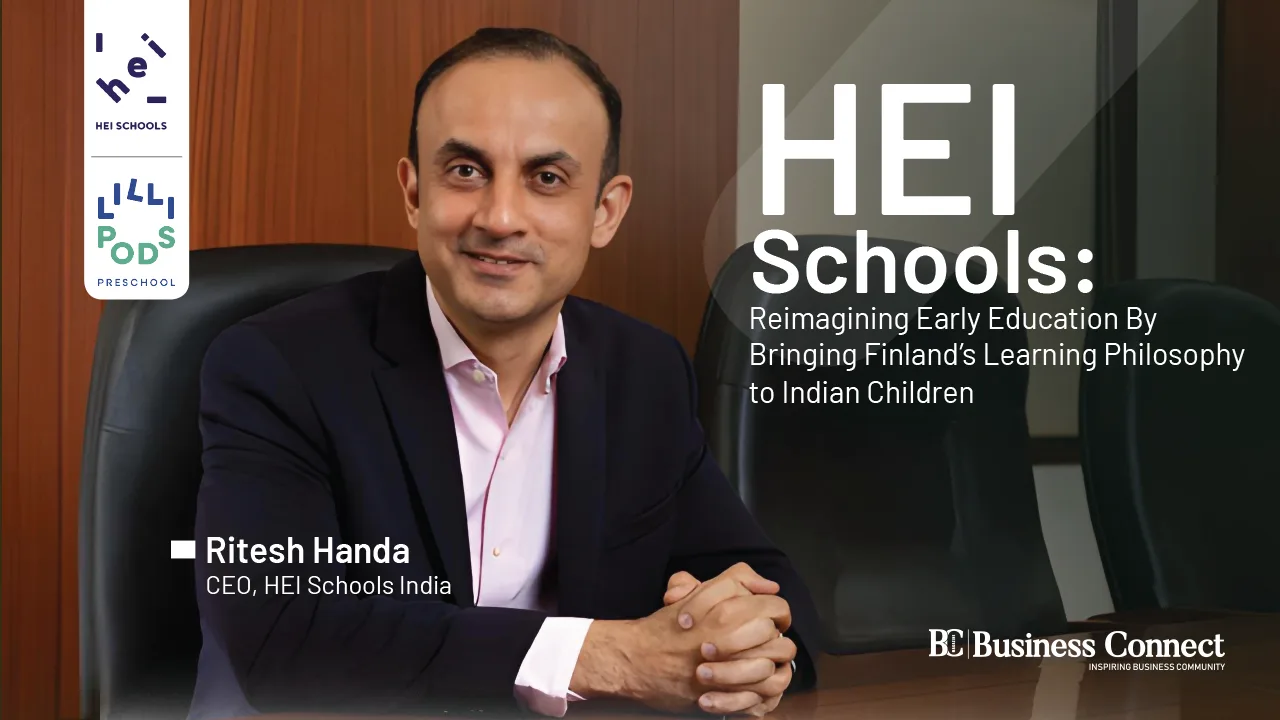
That changing mindset is exactly where HEI Schools sees its purpose. During an inspiring interaction with the face behind the organisation, Ritesh Handa, one thing became evident very quickly,this is not just another preschool franchise story. At its core, it is an attempt to rethink how early childhood education is approached in India.
Backed by Finland’s globally celebrated education philosophy, HEI Schools India is introducing a model that focuses less on rote learning and more on joyful, experiential and activity-based education. The organisation currently operates under two brands and both designed around Finnish pedagogy, while being adapted carefully for Indian learners and parents.
“What inspired this journey,” Ritesh shared during the conversation, “was a simple concern that early education in India often prioritizes performance and structure over a child’s natural curiosity and emotional well-being.” That concern eventually grew into a larger mission.
Beyond Books, Homework and Performance Pressure
For decades, Indian education, especially at the preschool and kindergarten stage, has revolved around memorisation. Children are often pushed toward academic milestones even before they fully understand emotions, communication or self-expression. Ritesh spoke openly about this pressure culture that many Indian families unknowingly normalize.
“Gone are those days,” he said, “when parents wanted their son to become Superman and their daughter to become Wonder Woman by memorising everything from A to Z. Today’s parents want their child to grow in a stress-free environment and become a confident child, not just an academically strong child.
Our key differentiator lies in bringing a truly child-centric, Finnish-inspired approach to early education, adapted thoughtfully for the Indian context. We focus on play-based learning, emotional well-being, and building independence rather than early academic pressure.
What sets us apart is the consistency of this philosophy in practice, through well-trained educators, structured yet flexible classroom frameworks, and a strong emphasis on teacher autonomy and continuous development.”
These distinctions became one of the strongest themes throughout the interaction. Instead of classroom environments built around rigid instruction, HEI Schools India follows a play-based and experiential model inspired by Finland, a country consistently recognised for having one of the world’s most respected education systems. The idea, according to the organisation, is simple: children learn best when they are emotionally safe, curious, expressive and actively involved in the learning process
The classrooms therefore move away from excessive homework, pressure-driven competition and repetitive learning patterns. Instead, thematic activities, social interaction, creativity and independent thinking are given equal importance. Interestingly, Ritesh repeatedly emphasized one thing i.e. confidence. Drawing from his years of experience working with leading preschool brands, he reflected on a gap he personally observed between Indian and international preschool environments.
“When I visited international preschools, children were naturally confident. They would speak, interact and express themselves freely. But in many Indian classrooms, children would hide behind teachers or avoid interaction with strangers despite being academically sharp.” For him, bridging that hesitation gap is just as important as building literacy or numeracy.
Two Brands, One Philosophy
HEI Schools India currently operates through two distinct preschool models i.e. HEI Schools and Lillipods. While both follow Finnish-inspired pedagogy and child-centric learning practices, they are designed for different market segments.
HEI Schools caters primarily to premium and upper-middle-class families seeking a more elevated international preschool experience, while Lillipods is positioned for middle-class and upper-middle-class households looking for accessible but quality early education.
However, Ritesh was careful not to position one above the other. “It’s like having two children,” he explained with a smile during the discussion. “You cannot say one is better than the other. They are simply suited for different markets.”
The differentiation lies mainly in infrastructure, classroom setup, teacher-child ratios and certain operational details. But philosophically, both institutions are rooted in the same belief, that children deserve joyful and pressure-free learning experiences.
The organisation began its India journey in late 2025 and has already established schools in cities including Hyderabad, Gurgaon and Bengaluru, with ambitious plans for expansion in the coming years. According to Ritesh, the long-term vision is to build nearly 500 schools across India over the next five to six years.
Creating Space for Inclusivity
One of the most profound moments of the interaction was when the conversation turned towards inclusivity and autism awareness. As the global rise in developmental and neurodivergent conditions continues, many Indian parents today are actively looking for schools that offer emotional safety and acceptance rather than exclusion.
Ritesh responded thoughtfully to the concern saying that while HEI Schools India is not a special needs institution, it strongly believes in inclusive learning environments. “We want children accepted for who they are,” he said. “And because our curriculum is activity-based, not pressure-based, it creates a more flexible, emotionally comfortable environment for many children.”
The organisation does not promote highly competitive classroom cultures in which children are constantly compared or ranked. Instead, emotional growth, participation and exploration become equally important markers of progress. This philosophy aligns strongly with the evolving expectations of modern Indian parents, many of whom now prioritise emotional wellbeing alongside academics.
Technology as an Enabler, Not a Replacement
Despite being deeply rooted in human-centric education, the organisation is also embracing technology carefully and strategically. According to the filled questionnaire shared by the company, AI and digital systems are primarily being used to strengthen curriculum planning, improve parent communication and streamline operations, not replace classroom interaction.
The emphasis remains firmly on keeping learning child-centric and screen-light. This balance between modern systems and emotional learning appears to be central to the organisation’s larger approach. We also asked Ritesh about his thoughts on innovation, to which he responded, “For me, innovation is meaningful only when it works on the ground.
While I draw inspiration from progressive models like Finland’s education system, I’m equally mindful of local realities such as parent expectations, cultural context, and operational feasibility. The balance comes from piloting ideas in small, measurable ways, gathering feedback, and refining continuously. This allows us to stay true to our vision while ensuring our solutions are practical, scalable, and genuinely impactful for the communities we serve.”
A New Direction for Indian Preschool Education
Perhaps the most striking part of the conversation was how often Ritesh returned to one foundational idea that the first six years of a child’s life matter immensely.
“Almost 95% of brain development happens by the age of six,” he explained passionately. “That foundation cannot be ignored. You can send your child to the best universities later, but the emotional and cognitive base is already built during early childhood.” And maybe that is exactly why HEI Schools India is gaining attention so quickly.
At a time when Indian parents are increasingly questioning traditional education models, the organisation is positioning itself not merely as a preschool chain, but as part of a broader shift in mindset, one that values confidence over comparison, curiosity over pressure and emotional development alongside academics.
For Ritesh and his team, the journey ahead is undoubtedly ambitious. But if there was one takeaway from the interaction, it was this: they are not simply trying to build more schools. They are trying to change how learning feels for a child. And perhaps, in today’s world, that may be the bigger revolution.