
-by Jaya Pathak
KleanGreen’s real achievement is not that it turns leaves into packaging; it is that it asks an uncomfortable commercial question India has postponed for too long: can sustainability compete with the brutal convenience of cheap plastic?
That question sits at the centre of Chetna Mukherjee’s entrepreneurial story. Her Bengaluru-based venture, KleanGreen India Sustainables, incorporated in 2021, is still small by conventional start up yardsticks. Public reports peg its initial capital at about Rs 3 lakh and recent turnover at around Rs 15 lakh. These are not numbers that usually excite growth investors trained to look for velocity, scale and market capture.
These facts deal an interesting story: – A company which is getting started with difficulty and the piece is really low, the business is trying to build value where the mainstream market think of such problems as rest nonsense not opportunities.
She studied design at a very prestigious National Institute of fashion technology but did not get into making packaging by following the usual or the expected path beat it She did not went through the common parts like studying polymer science or working in uh industrial procurement or venture backed climate technology.
Her entry point was design, waste and a discomfort with the visual excess of the pandemic years, when masks, gloves, PPE kits and plastic bags made environmental damage newly visible even to the urban middle class.
Plastic had always been around; Covid made it theatrical. It piled up on roadsides, in bins, near homes, and in the uneasy imagination of people who had begun to understand that disposal is often just a polite word for displacement.
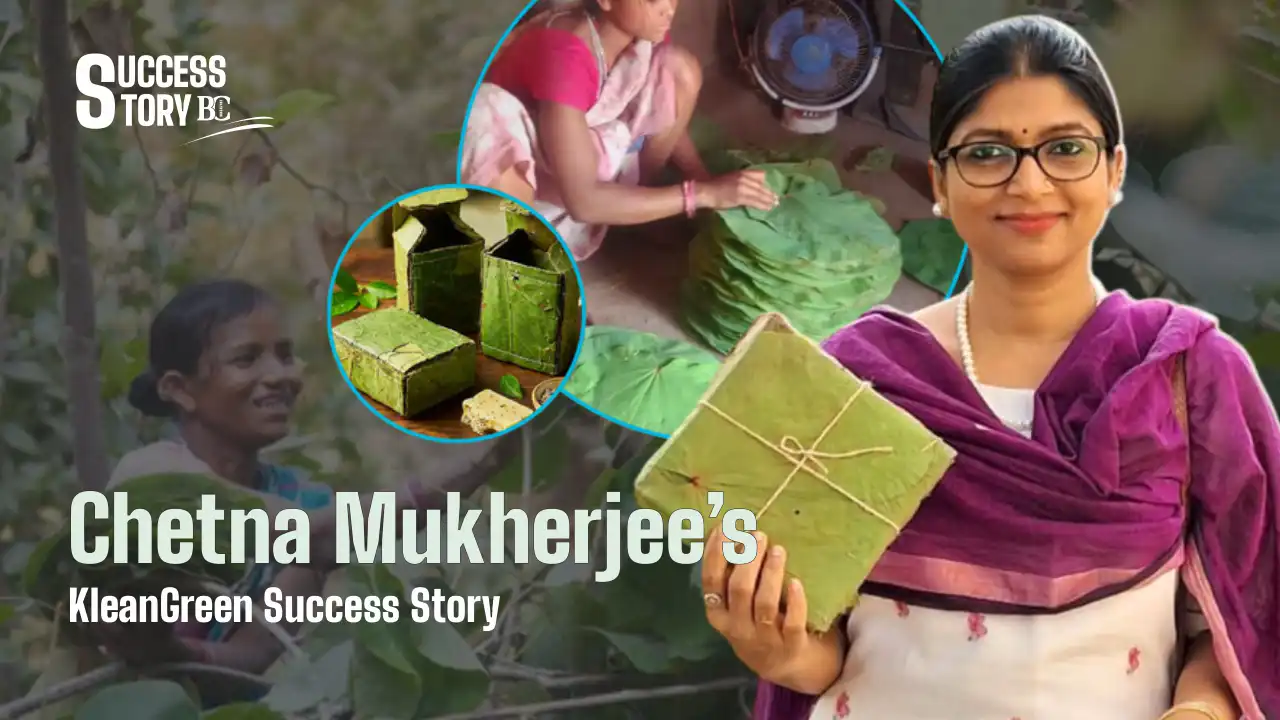
KleanGreen’s product idea borrows from an old Indian material culture rather than from a laboratory breakthrough. The company uses siali leaves, or Bauhinia vahlii, a fast-growing forest climber, to create compostable packaging and utility products. The logic is deceptively simple. Leaf plates have long been part of Indian food traditions, especially at large gatherings where low-cost, biodegradable serving ware made practical sense before sustainability became a boardroom phrase.
Mukherjee’s intervention was to pull that traditional material into a more contemporary design language: boxes, bags, envelopes and gifting formats that could sit in modern retail, corporate gifting, boutique food businesses and conscious consumer markets.
This is where the story becomes more than a founder profile. India has no shortage of sustainable product experiments. What it lacks is a sufficiently large market willing to pay for the true cost of responsible materials. Plastic is not dominant because consumers love it in any emotional sense. It is dominant because it is cheap, predictable, lightweight, scalable and ruthlessly convenient. Any alternative must therefore fight on several fronts at once: price, performance, availability, aesthetics and habit.
KleanGreen’s proposition is strongest when viewed through this lens. Its products are not trying to become invisible, as plastic packaging often does. They announce themselves. A leaf-based box has texture, irregularity and a certain cultural memory built into it.
That makes it particularly suited to occasions where packaging is part of the value proposition: festive gifting, handmade soaps, artisanal food, prasad distribution, boutique hampers and premium conscious retail. In such categories, the packaging is not merely a container. It is a signal.
But signals have limits. A business cannot live forever on goodwill. Mukherjee’s reported turnover, while respectable for a bootstrapped impact venture, also underlines the long road ahead. Sustainable packaging businesses often receive admiration faster than orders.
Buyers applaud the idea, then ask for lower prices, faster delivery and industrial uniformity. Corporates speak the language of ESG, but procurement departments still negotiate like procurement departments. Consumers say they want eco-friendly choices, but many abandon conviction at the checkout page.
That tension is not a weakness in KleanGreen’s story; it is the point of the story. The venture operates in the difficult space between moral preference and market behaviour.
Mukherjee’s design background gives her one advantage here. She appears to understand that sustainability cannot be sold only as sacrifice. It has to be desirable. The leaf box must not look like a lecture. It must look like something a customer would choose even before being told why it is better.
The social dimension adds another layer. KleanGreen’s model is publicly described as women-led, with sourcing and production links to tribal and underserved women’s groups. In practice, that means the company is not only building a product line but also attempting to preserve labour value in a market increasingly obsessed with automation.
It may look at marvel but it is commercially complicated because handcrafted production creates livelihood and authenticity but it can also create quality variation, bottlenecks and slower fulfilment. Scale demands process discipline. Social impact demands patience. Most young companies are lucky if they can manage one of these pressures. KleanGreen is attempting both.
There is a strategic risk in romanticising such models. India’s impact economy has too often converted rural or women’s labour into attractive storytelling while leaving the harder questions unresolved: who earns how much, how predictable is the work, who captures the margin, and can the supply chain withstand seasonal and demand shocks? KleanGreen will not be exempt from these questions as it grows. If anything, its credibility will depend on answering them with greater transparency over time.
Yet the venture’s instinct is sound. The future of sustainable consumption in India is unlikely to be built only by deep-tech material startups or large FMCG companies issuing recyclable claims. It will also be shaped by smaller enterprises that reinterpret indigenous materials for modern use cases. The opportunity is not nostalgia. Nostalgia rarely scales. The opportunity is translation: taking something familiar, improving its form, strengthening its utility and making it legible to a new buyer.
Mukherjee’s success, then, lies less in revenue size and more in market imagination. She has identified a category where India’s past may solve a part of its packaging future, provided design, logistics and pricing can be made credible. For founders, the lesson is sharp. Sustainability is not a brand filter to be applied after the product is built. It is a constraint that must shape sourcing, design, production, distribution and customer education from the beginning.
For investors, KleanGreen is a reminder that not every important business begins with software-like scale. Some ventures grow through supply chains, trust, training and slow customer conversion. Their curves are less dramatic. Their risks are messier. But they may build forms of resilience that spreadsheet-led enthusiasm often misses.
For corporate buyers, the implication is even more direct. If businesses want alternatives to plastic, they will have to participate in creating demand consistency. Occasional festive orders and sustainability campaigns are not enough. Vendors like KleanGreen need predictable volumes, fair payment cycles and design collaboration. Otherwise, India’s green manufacturing ecosystem will remain a gallery of promising prototypes.
Chetna Mukherjee’s KleanGreen is not yet a large company. That may be precisely why it deserves attention. At this stage, it is still close enough to its founding problem to retain moral clarity, and small enough for its choices to reveal the real frictions of sustainable enterprise. The next test will be whether it can move from admiration to adoption, from niche gifting to repeat institutional demand, from handcrafted charm to operational reliability.
The larger packaging market will not change because consumers feel guilty. It will change when alternatives become credible enough for businesses to use them without apology. It is an example of a new and getting started type of business, but it is moving toward the right goal.
In a country where people often talk a lot about environmental urgency, but such talks usually fade away without real action, her business suggest that the future might be perceiving a practical approach rather than vague promises. Sometimes it may arrive stitched from leaves, carrying the burden of proof in its hands.