
Written By Puja Bhardwaj
Starting a business the traditional way means writing a business plan, pitching it to an investor, building a team, launching a product and then trying to sell. And throughout the process, you faced a setback. This is not something that happened only with you. According to the research by Harvard Business School’s Shikhar Ghosh, 75% of businesses fail.
The lean startup model can help you avoid this and build a successful business. In this article, we have broken down the Lean startup model, its three core principles and how companies like Dropbox used it to go from idea to global-level success.
What is the Lean Startup Model?
This is a unique business approach that focuses on producing products that address the proven customer demand instead of assumptions. The Lean Startup Model was introduced by Eric Ries, prioritising validated learning, idea testing, collecting feedback, and making changes to reduce costs and failures. Contrary to the traditional business models, lean startups depend on iterative progress, flexible hiring, and varied performance metrics to enhance products and meet the actual market demand.
The Three Core Principles
The Lean Startup model has three principles: MVP (Minimum Viable Product), the Build–Measure–Learn Loop, and Rapid Testing and Validation.
MVP (Minimum Viable Product): MVP means the simplest and most testable version of a product. The core purpose behind this principle is to create the core features, launch in the market, and get user feedback. With this process, the founder understands the customers’ needs and does not waste their time or resources on unnecessary features.
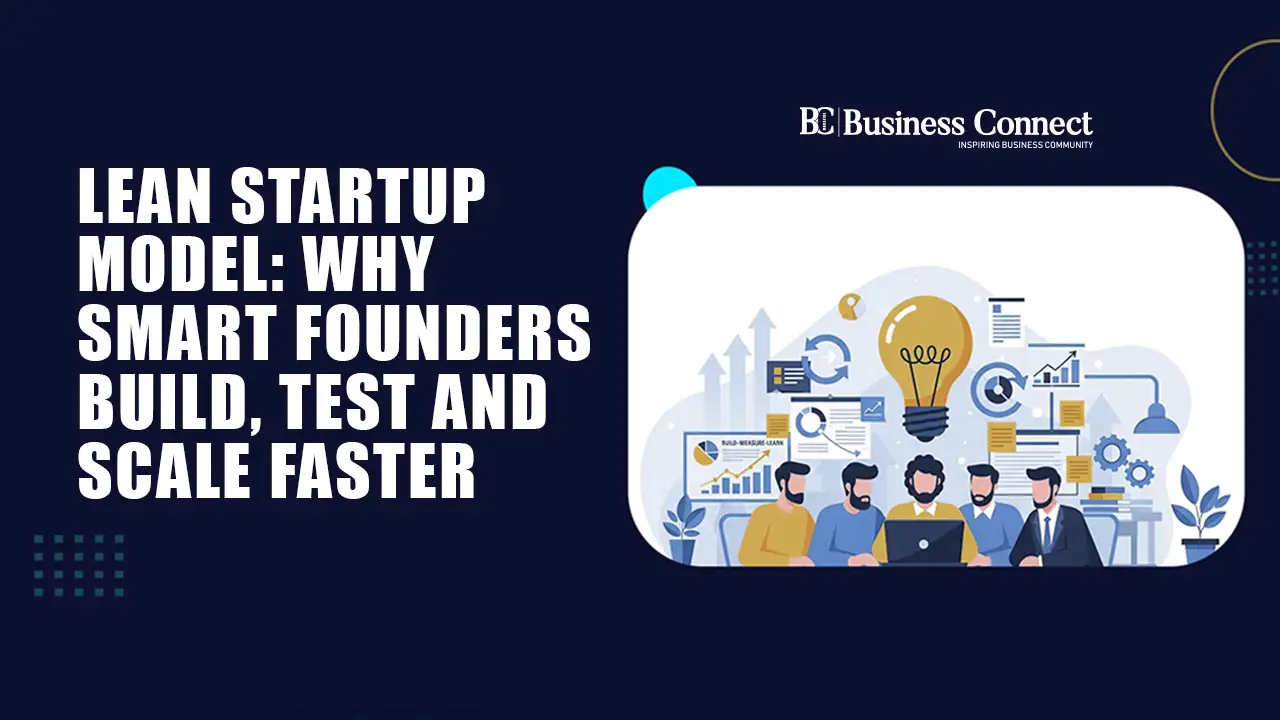
Build–Measure–Learn Loop: Working as the centre of the Lean Startup approach, this loop encourages entrepreneurs to measure their product performance, gather knowledge from the data, and make positive changes to their products. On repetition, the product becomes its better version.
Rapid Testing and Validation: Lean Startup is about instant testing and validation. Smart founders test their hypotheses and make the required changes in their strategies depending on the user feedback. This process not only reduces cost but also cuts the possibility of failure.
Spending Less and Scaling More: Founder’s Approach
The Lean Startup Model is a completely customer-centric approach that prioritises quick experimentation and iteration. Unlike traditional businesses that depend on long-term planning and operation, the Lean Startup focuses on helping founders validate assumptions and create a better product or service.
Startup founders go through numerous hurdles when starting a new business, from finding a core vision and understanding the customer pain points to hiring the right team. With the Lean Startup model, founders can easily overcome these challenges by working with quick experiments to check and refine their ideas. Smart founders are implementing the principles of the Lean Startup and easily building sustainable businesses that meet the needs of their customers and contribute positively to the world.
Case Studies to Understand the Success behind the Lean Startup Model
The Lean Startup Model has been adopted by multiple companies. Here are several case studies to understand their journey:
Dropbox: The idea behind Dropbox was to make file-sharing simple and easy. Instead of developing a functioning product, the company created a video of its concept and shared it with the people. The video gained great attention, validating the product demand. The product was developed. Further, the company kept improving it per their user feedback. Soon, Dropbox grew into a giant company with millions of users.
Airbnb: This is surprising, but Airbnb’s founders, Brian Chesky and Joe Gebbia, first built a website with photos of their own apartment and listed it for service. They did it – their idea of short-term rentals in private homes. They talked with users, got feedback and tried to understand their exact requirements. Soon, the idea expanded, and Airbnb rocked the hospitality industry.
Buffer: Buffer is a tool for post-scheduling. The visionary founder, Joel Gascoigne, first used a landing page to understand if there was a demand for a social media scheduling tool. Joel created a basic version that enables users to schedule posts and keeps adding new features as per feedback. Buffer has become a popular social media management tool today with a huge user base worldwide.
Overall, the lean startup model is a great approach to building a successful business, and that is why many smart founders are following this method.