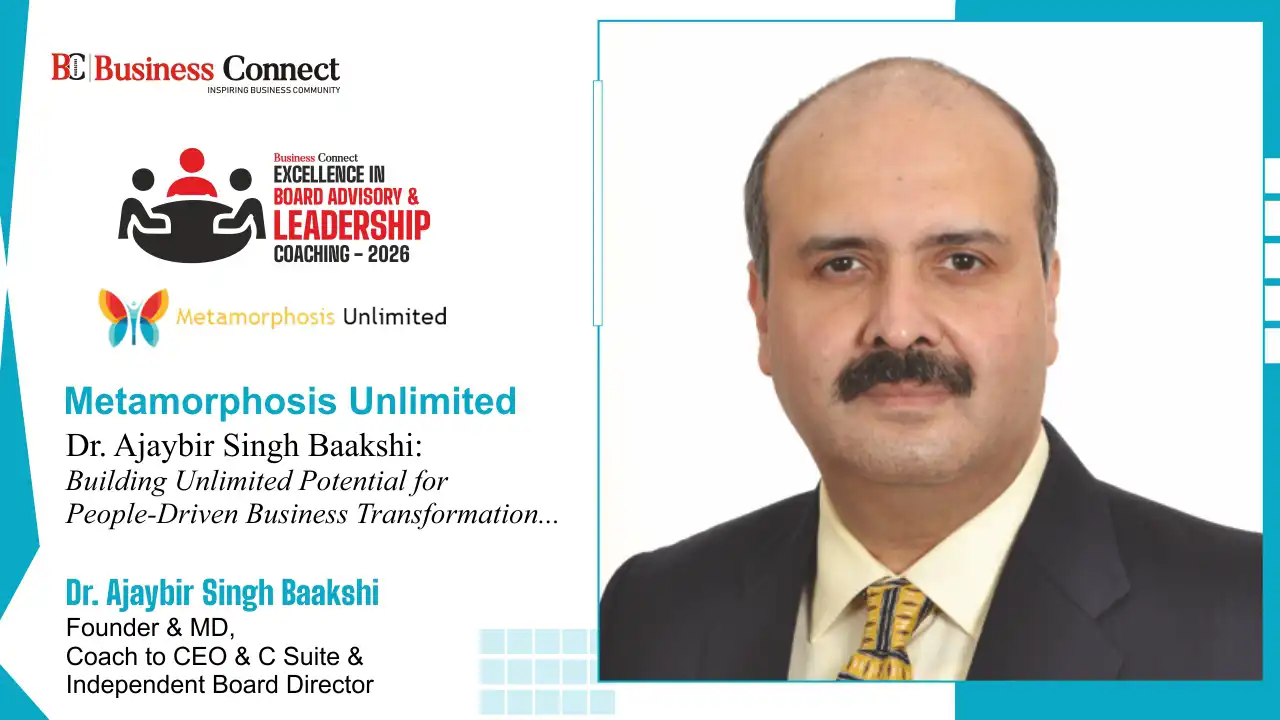
There’s a certain irony in naming a leadership consulting firm after a caterpillar’s most dramatic biological event, but for Dr. Ajaybir Singh Bakshi, Founder of Metamorphosis Unlimited, the metaphor was never accidental.
“Every organization goes through a stage of evolution or metamorphosis, like in the stage of a caterpillar to a butterfly,”
he explains, tracing the logic of a name he chose when he launched the company in 2016. Businesses, he says, move through the same arc that a caterpillar does from startup to growth, from maturity to, eventually, a phase where restructuring becomes unavoidable. Metamorphosis Unlimited was built to sit alongside organizations through every one of those stages. The “Unlimited” half of the name carries just as much intent as the “Metamorphosis.” Dr Bakshi says the firm was founded on a refusal to prescribe limits, a belief that organizations, and the people within them, have far more potential than they typically tap into.
“We want to work with organizations who are keen to not define boundaries, but work across unlimited boundaries by leveraging people’s potential,”
he says. A decade later, that founding conviction has hardened into something closer to a mission statement: to build profitable, sustainable organizations by harnessing the potential of the people inside them.
Three Decades Before the Startup
Dr Bakshi didn’t arrive at entrepreneurship as a first career. Before founding Metamorphosis Unlimited, he spent close to thirty years in corporate HR leadership, rising to Chief Human Resources Officer and board director of Vodafone’s Global Capability Centre, and serving as Director of HR for Prudential plc’s India operations before taking on a global role heading the insurance giant’s leadership and talent function. That trajectory through C-suite HR roles at multinational scale now underpins the practice he runs today, one that works across executive coaching, organizational consulting, leadership training, and leadership assessment.
On the coaching side, Metamorphosis Unlimited works with everyone from junior and mid-management professionals up to CEOs and CXOs, an effort Dr Bakshi personally leads for senior clients alongside a network of empanelled coaches. The focus areas read like a checklist for modern leadership: strategic thinking, navigating organizational change, building executive presence, communicating with impact, and developing what Dr Bakshi calls an “inspirational leadership style”, one built on influence rather than positional authority. Succession planning, high-performing team design, and governance and sustainability practices round out the senior leadership offering.
The consulting arm takes the firm into more structural territory, organization design and restructuring, and HR due diligence during mergers and acquisitions. It’s here that Dr Bakshi is most pointed about an industry blind spot. “While in mergers and acquisitions, there’s a lot of emphasis placed on finance, regulation and compliance, but enough weightage is not given to customers and on the people’s side,” he says. In his view, that imbalance is precisely why so many M&A deals fail to deliver on their promise and it’s the gap Metamorphosis Unlimited positions itself to close, working the people dimension for both employees and customers through the transition.
A third pillar of the business sets it apart in a crowded leadership-development market: facilitation and training built around the principles of martial arts. Dr Bakshi blends these with contemporary management frameworks to build skills like planning, prioritization, time management, conflict handling, and change management, an approach he’s documented in his second book. The firm rounds out its offering with leadership assessment work, evaluating capability and readiness for bigger roles across levels of management.
On Startups, Shortcuts, and What’s Wrong With the Ecosystem
Given his own leap from corporate life to entrepreneurship, Dr Bakshi has a clear-eyed, and at times blunt, view of India’s startup boom. Setting up a business has never been easier, he says, but running and sustaining one remains as hard as ever. His sharper criticism is reserved for a specific breed of founder and funder: those chasing valuation and quick wealth over durable business models.
“When your vision is only to make money and create valuation and run loss-making companies, sell your stake, I think one is doing a lot of damage to the ecosystem,” he says, adding that he deliberately avoids working with startups whose only motive is funding or personal wealth creation.
He points to a pattern he’s watched play out repeatedly, venture-funded companies burning through capital without building real discipline, missing salary payments, poaching talent with inflated pay only to lay people off within a year. Private equity’s typical three-to-five-year exit horizon, he argues, often drives exactly this kind of short-termism, and while he stops short of naming specific companies, he references wellpublicized compliance troubles at funded startups as evidence of a wider malaise. His advice to founders, particularly the family-run businesses he frequently works with, is to move beyond founder-dependency and invest deliberately in processes, people capability, and technology.
Technology, AI, and the Future of Work
Unprompted by the original questionnaire but clearly a subject he’s thought deeply about, Dr Bakshi offered an extended take on the anxiety gripping today’s workforce over AI. His framing is a familiar one, glass half full versus half empty, but he applies it with historical grounding. Routine, operational, cost-inefficient roles are the ones genuinely at risk, he argues, much as they were when computers first entered Indian workplaces decades ago. That earlier disruption didn’t shrink the economy; it transformed it, moving India from an agriculture-driven GDP to one now anchored by IT and services. “India would have never become the top five economic superpower had we not invested in technology,” he says.
His advice to the next generation entering the workforce is less about chasing credentials than continuously updating capability. “Without skills, certificates have no meaning,” he says, urging young professionals to prioritize upskilling and relearning over brand names and paper qualifications. In his framing, technology itself doesn’t make people redundant, the failure to adapt does.
That same conviction shapes how Dr Bakshi runs his own research function. Metamorphosis Unlimited maintains partnerships with business schools and market research firms, and Dr Bakshi says he actively uses AI tools himself, cross-validating insights from three different AI products against findings from his research partners.
He’s currently expanding into partnerships with global B-schools and, notably, with contemporary research firms he sees as less bound by academic tradition and more attuned to real market conditions, including those studying broader social trends that inevitably ripple into business. One live initiative, still under wraps for confidentiality reasons, involves building an AI-powered coaching application aimed at profiling client behavior and predicting the impact of coaching on skills and performance over time.
Marketing, and a Philosophy of Leadership
Asked about marketing’s role in the modern business landscape, Dr Bakshi is unambiguous: without it, few organizations can scale or sustain themselves. Effective marketing, in his view, is what allows a business to differentiate itself, build awareness among the right audience, and clearly communicate the problem it solves for customers. It’s a theme that connects naturally to his broader philosophy of leadership, which he has written about extensively in two books, Built to Outperform, on building high-performing teams, and Build Your Leadership Skills: Lessons from Martial Arts, both available on Amazon and Flipkart.
Distilled to its essence, Dr Bakshi’s view of leadership has little to do with technical capability or personal strength. “It is about how do you inspire people to become the best versions of themselves, and contribute to transformation organization results,” he says, a philosophy that, in many ways, brings the conversation full circle to the name he chose for his company a decade ago: metamorphosis, driven by unlimited human potential.